

Defining potential, and doing something with the grid afterward, is where these programs fail.
This is the last of four pieces expanding on The Four Questions Every Performance Management Program Must Answer. Question four is how the program grows people, and it is the one most organizations bolt on last.
The 9-box is still the standard tool. The Talent Strategy Group’s 2025 Potential Report, covering more than 300 companies, found 61 percent use one. The same organizations rate their own accuracy at predicting potential at 44 percent, and only 36 percent think their process works.
That gap is not a grid problem. It is what happens when you plot an axis nobody has defined.
Potential is not performance, and the difference is expensive
The 9-box asks for two ratings. Most organizations produce one and a half, because the potential score quietly becomes “performance, but I also like them.”
There is now good evidence about what that costs. Researchers studied an international professional services firm that switched in 2013 from rating performance alone to performance plus an explicit potential assessment on a 9-box, across 7,709 employee-years and 962 promotions. Promoted employees performed worse after the change than before it. The reason: the potential ratings predicted how well someone was doing in their current job, not how well they would do in the next one. The authors call it a source of the Peter Principle, and that is fair.
So the practical question is not whether to use a 9-box. It is whether your second axis measures anything your first axis does not.
Define potential before you rate it
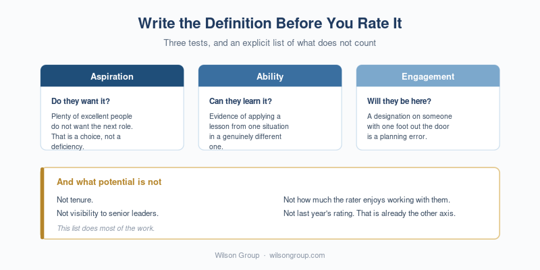
Write the definition down before a single manager opens the template. Three tests to include, and no more than five:
Aspiration. Do they actually want the next role? Plenty of excellent people do not, and rating them low on potential for it is a category error.
Ability. Can they learn what the next role requires? Gartner’s published model pairs aspiration and ability with engagement. Korn Ferry’s version centers on learning agility, applying a lesson from one situation in a different one. Both are reasonable starting points. Neither is precise, and the academic view is that learning agility in particular remains loosely defined, so do not over-engineer this.
Engagement. Will they be here? A high-potential designation on someone with one foot out the door is a planning error, not a development plan.
Then write down what potential is not, because that list does the real work. Not tenure. Not visibility to senior leaders. Not how much the rater enjoys working with them. Not last year’s rating, which you already have on the other axis.
Make the grid produce actions, not labels
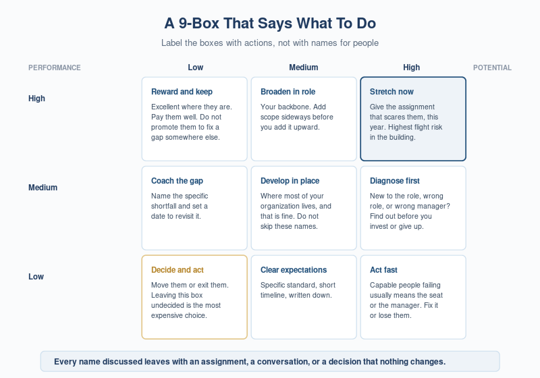
The failure pattern is a completed grid and an empty calendar. Four things fix it.
Calibrate potential the way you calibrate performance. Same room, same evidence standard, same challenge on both extremes. A potential rating nobody had to defend is worth nothing.
Bring different evidence. A manager arguing for high potential should point at something outside the current job: a stretch assignment handled well, a lateral move, a situation the person had never seen before. Last year’s results are already on the vertical axis.
Time-box the grid. Placing people should take a fraction of the meeting. The rest goes to what happens next, name by name.
Leave with moves, not boxes. Every person discussed should have one of: a specific assignment, a specific conversation, or a decision that nothing changes this year. Write down who owns it and when it happens.
So how do you keep them?
This is the fair objection to everything above. If potential does not move pay, what actually retains a high potential?
The distinction that resolves it: do not pay for the potential rating. Pay for what high potentials do.
A rating is a forecast, and forecasts should not move base pay, which is permanent, compounds, and is very hard to unwind when the forecast turns out wrong. There is a second reason. Potential ratings carry demonstrated bias. In a study of 29,809 management-track employees, women received higher performance ratings and substantially lower potential ratings, and those potential ratings accounted for roughly half the gender promotion gap. The women then outperformed the men who had received the same potential score. Feed that into base pay and it compounds permanently.
But high potentials should be doing visibly different work, and different work moves money through channels that are already defensible.
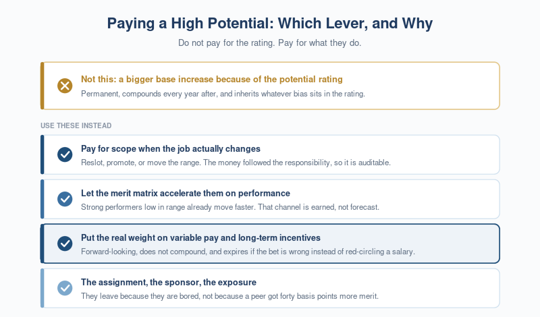
Pay for scope. If someone picks up a bigger remit, that is a job change. Reslot it, promote them, or move them to a higher range. The money followed the responsibility, which is auditable and survives a pay equity review.
Let the merit matrix do its job. High potentials usually also perform, and a matrix that accelerates strong performers sitting low in range is already moving them faster than their peers. That channel is performance-driven, not forecast-driven.
Fund promotions properly. Underfund the promotion and off-cycle budget and managers start bending the merit matrix to compensate, which is how potential ends up in base pay through the back door.
Put the real weight on variable pay and long-term incentives. A retention award or a grant with a multi-year vest does the retention job without embedding a forecast permanently in base. It is forward-looking by design, it does not compound, and if the bet is wrong it expires rather than becoming a red-circled salary in four years. Around a fifth of organizations already extend long-term incentive eligibility to high potentials.
And remember what actually holds them. High potentials leave because they are bored, not because a peer got forty basis points more merit. The assignment that scares them, an executive sponsor, exposure to a part of the business they have never seen. That is the main event, not the consolation prize for withholding pay.
Two cautions. Attaching equity or a retention award to a high-potential list inherits exactly the bias problem above, just with a longer fuse, so put money behind the list only once the definition and the calibration are sound. And if someone is genuinely below market, none of this retains them. That is a market problem wearing a retention costume, and you fix the base pay first.
Succession starts with roles, not people
The instinct is to start at the top of the org chart. Start with the roles where a gap would hurt most instead, which is not the same list. CIPD’s guidance makes the point that organizations taking a serious approach identify business-critical roles at all levels, including senior specialists who have no interest in managing anyone.
Then build depth against those roles. The US Office of Personnel Management’s succession model uses a bench strength ratio: a 2:1 ratio means two credible candidates ready for a given role at any point. It is a useful target to argue about even if you never hit it.
One caution on vocabulary. “Ready now,” “ready in one to two years” and “ready in three to five” are practitioner convention. No standards body defines them and there is no validity evidence behind the tiers. If you use them, define at your own company what “ready now” actually means, because otherwise every leader in the room is using a different bar.
And the gap is usually in the follow-through. In the same research, 82 percent of organizations include critical roles in succession planning, but only half have a ready-now successor for them, and only a quarter maintain development plans for the people currently in those roles.
Things to watch
Decide your transparency policy before someone asks. Only 39 percent of organizations tell people they are designated high potential. Either answer is defensible. Being unable to answer when an employee asks directly is not.
Nobody ever gets off the list. Only 13 percent tell people when the designation has been removed. If your list only grows, it stops meaning anything within three cycles.
A formal program is not automatically a better program. Research on high-potential identification has found formal programs performing no better than informal ones. The rigor that matters is in the definition and the follow-through, not the software.
Where this lands
Define potential in writing, calibrate it as hard as you calibrate performance, start succession from the roles that matter rather than the titles at the top, and measure the program by the moves it produced rather than the grid it filled in.
That closes the four questions. What you measure, how you rate it, how it links to pay, and how it grows people. Answer them deliberately and the form nearly writes itself. Skip them and no amount of process polish will save the program.
The full series
- What do we measure? The weighting decision nobody makes on purpose
- How do we rate it? Calibration is the part that actually matters
- How does it link to pay? Building a merit matrix that actually differentiates
- How does it grow people? The 9-box is the easy part
Let’s talk
Rethinking your performance management program, or starting from scratch? Wilson Group has helped over 350 organizations design employee total compensation, executive rewards, and sales incentive programs that fit their stage, scale, and mission. Schedule a conversation →
