

Most programs pick a goal framework and let the weighting happen by default. That is backwards.
This is the first of four pieces expanding on The Four Questions Every Performance Management Program Must Answer. The first question sounds simple: what do we measure? Goals, behaviors, or both.
Most design conversations answer it by picking a framework. SMART or OKRs. A competency model or none. Those are real choices, but the framework is not what changes behavior in your organization. The weighting is, and in most programs, nobody ever made that call out loud.
Start with the weighting
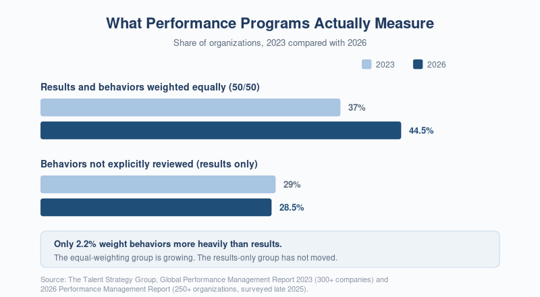
Roughly three organizations in ten do not evaluate behaviors at all, and among those that do, an even split between results and behaviors is the most common answer. That comes from the Talent Strategy Group’s 2026 Performance Management Report, covering more than 250 organizations, with a comparable picture in their 2023 wave.
Useful context, but not an answer. Here is the test to run on whatever split you are considering. Can the behavior weight actually change a rating?
Take a five-point scale and someone who earns a 4 on results and a 2 on behaviors. At an 80/20 split the composite is 3.6, which in most programs rounds back to a 4. At 70/30 it is 3.4. At 50/50 it is 3.0, a full point lower and a different conversation entirely.
Below roughly 30 percent, behaviors become commentary. The form collects them, the review mentions them, and the number does not move. You have bought the administrative cost of rating behaviors without buying any of the differentiation.
That is the weighting question that matters. Not what is standard, but whether the weight you chose is large enough to produce a different answer than results alone would have produced.
Then let it move with scope
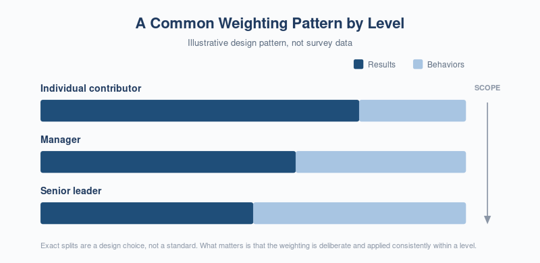
A results-only approach often works well for individual contributors. Outcomes are attributable, and the collateral damage of how someone got there is contained. The same approach applied to a senior leader measures the smallest part of the job.
Things to watch
Roles with no measurable output. Shared services, internal support, compliance. Do not invent a metric because the template has a field. Measure the service commitments the function genuinely owns, such as cycle time, accuracy or coverage, and weight behaviors more heavily.
Behaviors that are really personality. “Executive presence” and “attitude” are not behaviors. If you cannot describe what someone did, it does not belong on the form.
Goals written by the manager alone. An unowned goal and an imposed goal fail the same way at year end, because nobody argued about it in January.
Weighting that varies by manager. If each leader sets their own split, you have four programs. Set it centrally, by level.
Goal-setting windows that drift. If half the organization sets goals in January and half in April, you are comparing different time periods at year end, and no amount of calibration will fix it.
Where this lands
Pick a framework, but do not spend your political capital there. Spend it on three things: a weighting large enough to change an answer, an owner named in every goal, and a clear line between the goals that stretch people and the goals that pay them.
Settle those and question two gets easier, because what you have chosen to measure largely determines what kind of scale can rate it fairly. That is next in this series.
Coming up in this series
- Calibration, and why it starts at goal setting
- Building a merit matrix that actually differentiates
- Performance vs. potential: the 9-box and succession planning
Let’s talk
Rethinking your performance management program, or starting from scratch? Wilson Group has helped over 400 organizations design employee total compensation, executive rewards, and sales incentive programs that fit their stage, scale, and mission.
