

Before you debate rating scales or merit budgets, get clear on what your program is actually trying to do.
Performance management programs rarely fail because of poor execution. They fail because the foundational design choices were never made deliberately – and the program ends up trying to be everything to everyone.
In our work with organizations across industries, we have found that every well-functioning program answers the same four questions before any rating form gets drafted. Get this right, and the rest of the design tends to fall into place. Get it wrong – or skip them – and no amount of training, technology, or process polish will save the program.
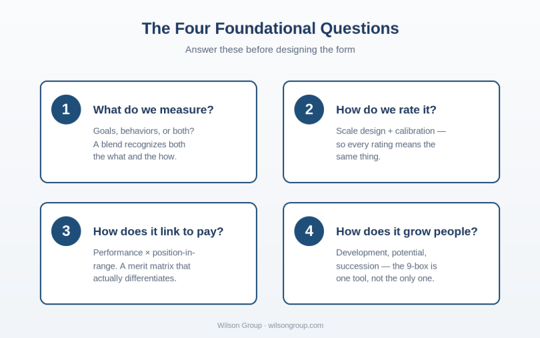
1. What do we measure?
Goals, behaviors, or both? A goals-only program tells you what got done, but not how. A behaviors-only program captures culture and collaboration but can drift into subjective “likeability” ratings. Most well-designed programs land in the middle – a blend that recognizes both the outcomes someone delivered and the way they delivered them. Coming soon in this series: SMART goals, OKRs, and how to choose between them.
2. How do we rate it?
Once you have decided what to measure, how do you score it? A 1–5 scale, a 1–4 scale that forces a directional call, or descriptive tiers instead of numbers? Just as important: how do you keep one manager’s “4” from meaning something different than another manager’s? That is where calibration comes in – a step many programs skip and almost always regret. Without it, every downstream decision, especially pay, rests on inconsistent inputs. Coming soon: Rating scale design – and the calibration step most programs miss.
3. How does it link to pay?
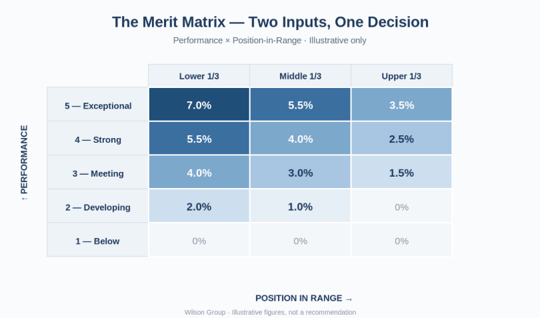
A flat merit increase across the board is simple, but it does nothing to differentiate performance. A two-dimensional merit matrix – performance crossed with position-in-range – lets you accelerate strong performers who are below market, while moderating raises for those already near the top of their band. It is powerful, but it requires disciplined salary band management. And three inputs – budget, rating distribution, and where your people sit in their ranges – all shape what the matrix can actually deliver.
Before any of this – pay design has to anchor to a clear philosophy: The Foundation of Strategic Pay: Your Compensation Philosophy.
A note on fairness: if you are linking ratings to pay, the integrity of the link matters as much as the matrix itself. I have written elsewhere about why pay equity isn’t one number, and how to prepare for a pay equity audit – both worth a read if you are revisiting your pay practices alongside your performance program. Coming soon: Building a merit matrix that actually drives differentiation.
4. How does it grow people?
Some programs stop at the annual rating. Others layer in a potential dimension – the 9-box grid being the most well-known framework, originally developed by McKinsey for GE in the 1970s for business unit planning, and adapted for talent management decades later. The 9-box plots performance against potential and supports succession planning and targeted development. Whether you need a formal tool depends on your scale, and where leadership transitions matter most. Coming soon: The 9-box, succession planning, and when it is worth the lift.
The simple-to-sophisticated spectrum – there is no single “right” answer to any of these questions. Performance management lives on a spectrum:
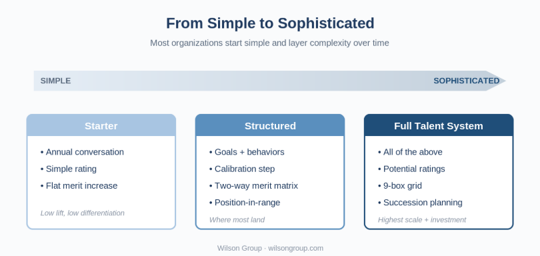
Most organizations start simple and layer complexity over time. The right question is not “which is best?” – it is “what fits us now, and what is the path if we need to grow it later?”
Three things we see go wrong:
When these foundational choices are not made deliberately, the same patterns surface again and again:
- Ratings cluster in the middle. Managers default to “Meets” to avoid hard conversations, and the program loses its ability to differentiate.
- Calibration gets skipped. A “4” from one team stops meaning what a “4” from another team means – and pay decisions downstream are built on sand.
- Pay and performance get conflated. When the rating discussion happens with the raise on the table, the rating drifts to justify the raise – not the other way around.
Where to start
If your organization is rethinking its performance program, the temptation is to jump to the form. Resist it. Get alignment on the four foundational questions first – what you measure, how you rate, how it links to pay, how it grows people – and the form will almost write itself.
Coming up in this series
- SMART goals vs. OKRs: choosing the right goal framework
- Behaviorally Anchored Rating Scales (BARS): making behavior ratings objective
- The merit matrix, explained
- Calibration: the keystone step most performance programs skip
- The 9-box grid: when it earns its place, and when it does not
- Writing performance goals that do not read like a job description
Let’s talk Rethinking your performance management program – or starting from scratch? Wilson Group has helped over 350 organizations design employee total compensation, executive rewards, and sales incentive programs that fit their stage, scale, and mission.
