

By Chelsea Martens, Senior Compensation Consultant, Wilson Group
Most pay equity audits don’t fail on the numbers. They fail on the documentation that’s supposed to explain the numbers.
If you’re reading this, there’s a good chance you’re on an HR team that’s been asked to “get ready for a pay equity audit” — but nobody gave you extra headcount, budget, or a spare quarter to do it. That’s the reality for most small and midmarket organizations. Pay equity has risen to a leadership priority, but the work lands on an HR team that’s already stretched thin.
The good news: you don’t need a huge team or a huge budget. You need structure. Here’s the simple framework I use when helping lean HR teams get audit-ready.
In one multi-country engagement I led, a client had clean pay structures and a solid job architecture. On paper, they were ready. But they hadn’t documented how compensation exceptions were approved. That single gap turned a routine audit into a six-week remediation project — not because anything was truly wrong, but because nobody could prove the exceptions weren’t arbitrary. That’s the kind of thing I want to help you avoid.
Step 1: Know Which Regulators Apply to You
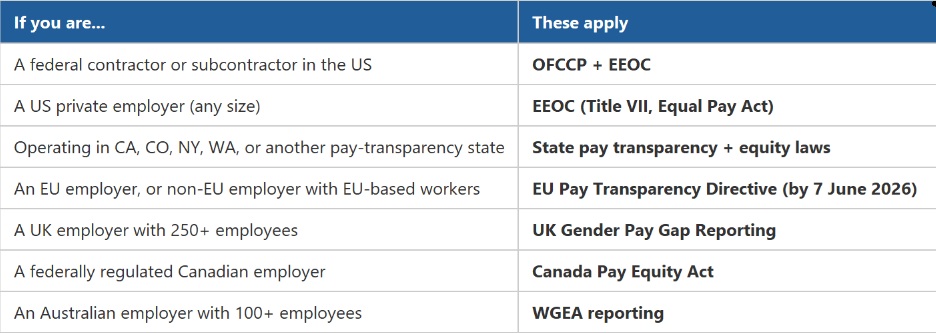
Start by mapping the landscape. Different agencies care about pay equity for different reasons, and which obligations apply depends on where you operate and who you employ. Use the table below to orient quickly, then dig into the detail below it if you need more depth.
Quick-Reference: Which Regulations Apply to You?
United States
OFCCP (Office of Federal Contract Compliance Programs)
Applies to federal contractors and subcontractors. Requires:
- Annual compensation analyses
- Demonstration of non-discriminatory pay practices
- Documentation of job structure, salary ranges, and pay decisions
EEOC (Equal Employment Opportunity Commission)
Enforces Title VII and Equal Pay Act protections. Investigates:
- Gender and race-based pay disparities
- Job classification and comparability issues
State-level pay equity laws
Especially strong in California, Colorado, New York, and Washington. These laws often include:
- Pay transparency and salary range disclosures in job postings
- Restrictions on asking about salary history
- Required pay equity analyses for certain employers
Global and International Standards
If your workforce crosses borders, additional frameworks may apply.
EU Pay Transparency Directive (2023/970)
All EU member states must transpose this directive into national law by 7 June 2026. Key requirements:
- Salary transparency for job applicants — pay ranges disclosed before interviews
- Right for employees to request pay information for peers doing equivalent work
- Gender pay gap reporting for employers with 150+ employees, starting June 2027 (based on 2026 data)
- Mandatory remedial action and joint pay assessments when unjustified gaps exceed 5%
- Shift of the burden of proof to the employer in pay discrimination claims
Penalties for noncompliance include fines, worker compensation claims, and potential exclusion from EU public procurement. Member states can also impose stricter rules on top of the EU baseline.
UK Equality Act and Gender Pay Gap Reporting
- Mandatory annual reporting for employers with 250+ employees
- Public disclosure of gender pay gaps (mean and median)
- Written statement required to explain the data
Canada (Pay Equity Act)
- Requires proactive pay equity plans for federally regulated employers
- Regular re-evaluation cycles with employee and union involvement
- Ontario and Quebec add provincial requirements on top
Australia (WGEA — Workplace Gender Equality Agency)
- Mandatory gender pay gap reporting for employers with 100+ employees
- Public disclosure of employer-level pay gap data
- Workforce composition and governance analysis required
The common theme across every jurisdiction: regulators want proof that compensation decisions are structured, defensible, and consistent. Structure is your strongest defense.
Step 2: Separate Two Different Questions
Pay equity always answers two different questions. Confusing them leads to bad analysis — and worse, bad documentation.
Question 1: Are people paid fairly for the work they do?
This is the lens OFCCP uses for compensation discrimination, and it’s what most US-based audits focus on. It’s answered through Controlled Pay Gap analysis — comparing pay within the same job, level, and pay range. When you control for those factors, any remaining gap is either explainable by legitimate business reasons (experience, tenure, performance) or it’s a problem you need to fix.
Question 2: Who holds the higher-paying roles?
This is what most global reporting frameworks — the EU Pay Transparency Directive, UK reporting, Australia’s WGEA — primarily care about. It’s answered through Raw Pay Gap analysis — simple averages across groups, without controlling for job or level.
Both matter. But only the first is directly solved by compensation decisions. The second reflects workforce composition — who you hire, promote, and retain — and requires broader workforce strategy to address.
For a deeper look at why one number can’t tell the whole story, see my companion piece, Pay Equity Isn’t One Number: A Better Way to Measure Fairness in Today’s Workforce. For audit prep specifically, the takeaway is: know which question your regulator is asking and make sure you’ve run the right analysis for it.
Step 3: Build the Foundation Before You Run Numbers
The most common mistake I see: companies start with spreadsheets before they’ve built structure. That’s a fast path to audit findings you can’t explain.
Before running any analysis, confirm the foundational elements are in place:
- Job architecture exists
- Levels are consistently applied across the organization
- Salary ranges are defined and current
- Hiring ranges are enforced
- Merit processes are standardized
- Exception approvals are documented (remember the story from the opening — this is where lean teams most often get caught)
Without this foundation, your audit will identify problems you can’t explain or defend.
Step 4: Document Governance
Regulators care less about perfection and more about process. You should be able to show:
- How jobs are evaluated
- How pay ranges are created
- How offers are approved
- How merit is allocated
- How exceptions are reviewed and documented
Documented governance is what makes your audit defensible. Even when gaps surface — and they often do — a clear explanation of how decisions were made dramatically reduces risk.
Step 5: Run the Right Analysis
At minimum, your audit should include:
Controlled pay gap analysis by:
- Gender
- Race and ethnicity, where legally allowed
- Job and level
Documentation of:
- Legitimate explanatory factors for any observed gaps
- Adjustment decisions and their rationale
- Review cadence and governance sign-off
Step 6: Create a Repeatable Audit Cycle
Pay equity isn’t a project. It’s a system. Strong organizations:
- Audit annually or bi-annually
- Tie audits to merit cycles so adjustments can happen together
- Report results to leadership and, when appropriate, the Board
- Track progress year over year
That’s exactly what regulators — and increasingly, employees and investors — expect.
The Cost of Getting It Wrong
For lean HR teams, audit-readiness competes with ten other priorities. So, it’s worth knowing what’s actually at stake if pay equity prep gets pushed off.
- OFCCP findings can lead to back-pay awards, corrective pay adjustments, and — in serious cases — loss of federal contracts
- EU Pay Transparency Directive noncompliance can trigger fines, worker compensation claims, and exclusion from EU public procurement
- UK reporting failures are published publicly and have caused significant reputational damage to well-known employers
- Litigation and settlements — high-profile equal pay cases in the UK, France, and Belgium have awarded millions after employees gained access to the pay transparency data the directive mandates
- Employee trust — once employees suspect pay inequity (even perceived inequity), retention and engagement drop. Rebuilding that trust takes far longer than preventing the perception in the first place
For a small HR team, the biggest cost is rarely the fine itself. It’s the six to twelve weeks of emergency remediation work you weren’t staffed to do — the hours stolen from everything else on your list.
Final Thought
The goal of pay equity isn’t to survive an audit. It’s to build the kind of compensation system you’d be proud to have examined — by regulators, employees, or your own board.
That’s a very different posture than reactive compliance. And for a small HR team, it’s actually easier. Because once the structure and documentation are in place, audits stop being events. They become something you’ve already done.
Get Audit-Ready with Wilson Group
If you’re reading this as the one person on your team responsible for compensation, and the list above feels overwhelming, here’s how Wilson Group can help.
→ Schedule a 30-minute pay equity readiness conversation
→ Download the 9-section Pay Equity Audit Preparation Worksheet
→ Talk with a compensation expert about your specific regulatory exposure
