

Options, phantom stock, SARs, cash plans, deferred comp – a 10,000-foot view of what’s out there, and which designs fit which companies.
Base salary rewards the job. An annual bonus rewards the year. But the decisions that actually build enterprise value – the multi-year bets, the disciplined reinvestment, the choice to stay when a competitor comes calling – play out over a much longer horizon. A long-term incentive (LTI) plan is how you put real rewards behind that horizon.
For private and closely held companies, LTI is also where the hardest question in all of compensation lives: are we willing to share real ownership, or not?
Public companies mostly default to equity. Private owners have a choice – and the right answer depends far more on your stage, your ownership philosophy, and your exit intentions than on any “best practice.”
Over 50% of private companies above $100M in revenue maintain a formal LTI plan, jumping to roughly 80% for firms above $1B – with PE- and VC-backed firms adopting at higher rates than family businesses (Grant Thornton / Chief Executive Group).
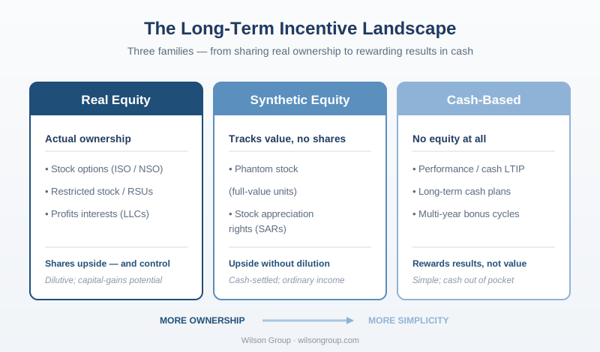
The long-term incentive landscape: three types, from real equity to synthetic equity to cash.
Nearly every LTI vehicle falls into one of three types, arranged by how much ownership you’re prepared to part with:
Real equity gives people an actual slice of the company. Provides maximum tax efficiency and alignment but dilutes control.
Synthetic equity (phantom stock and stock appreciate rights) Delivers economic upside of ownership without issuing a single share.
Cash-based plan skips equity entirely to reward multi-year results in dollars.
1. Real equity – options, restricted stock, and profits interests
This is the “true ownership” path.
Stock options grant the right to buy shares at a fixed price, rewarding growth post grant. Incentive stock options (ISOs) can qualify for capital-gains treatment if strict holding periods are met; non-qualified options (NSOs) are taxed as ordinary income on the spread at exercise (NCEO).
Restricted stock and RSUs grant the shares, subject to vesting. Restricted stock is taxed as ordinary income as it vests unless the recipient files a Section 83(b) election within 30 days of grant to pay tax on the lower grant-date value (RSM).
Profits interests are the LLC/partnership model and among the most tax-efficient vehicles available. (Rev. Proc. 93-27/2001-43) Holders share only in future appreciation above a “hurdle” generally taxed as capital gain at exit (The Tax Adviser).
Best fit: Growth-stage businesses looking to conserve cash, and PE-backed platforms offering management “rollover” equity. Real equity brings minority-owner dynamics, information rights, and buy-sell complexity when executives exit.
2. Phantom stock – the upside of ownership, none of the shares
A contractual promise to pay a cash bonus tied to the value of a set number of “units”. Existing owners keep their equity and their control intact (NCEO).
Tax and cash considerations Governed strictly by IRC §409A requires that payout triggers must be precise to avoid immediate taxation plus a 20% penalty. Payouts are taxed as ordinary income, deductible by the company when paid (RSM). Cash settlement requires clear funding planning.
Best fit: Family-owned companies wanting to reward key leaders like owners without diluting equity and PE-backed companies aligning management team to an upcoming exit. See our blog designing an LTIP with phantom stock for a detailed description.
3. Stock appreciation rights (SARs) – phantom’s leaner cousin
SARs pay only the increase in unit value over a baseline, price.
Valuation: Can qualify for §409A exemption if set at or above fair market value. However private companies must rely on a defensible, contemporaneous valuation, not a back-of-the-envelope estimate.
Best fit: owners who want payouts tied strictly to value appreciation, and who have a credible, repeatable valuation process each cycle.
4. Cash-based long-term incentive plans (LTIP)
The simplest model. A cash LTIP pays out over multi-year performance cycles (typically rolling three-year cycles) based on financial metrics like revenue growth, EBITDA, or cash flow.
Trade-Offs: This approach sidesteps equity, dilution, and valuation mechanics entirely. The drawback is that it requires direct cash outlays from company reserves and builds financial alignment rather than a true owner’s mindset. It works well for family-owned companies not looking to share ownership, or any business that wants to reward sustained operational performance without giving up a stake.
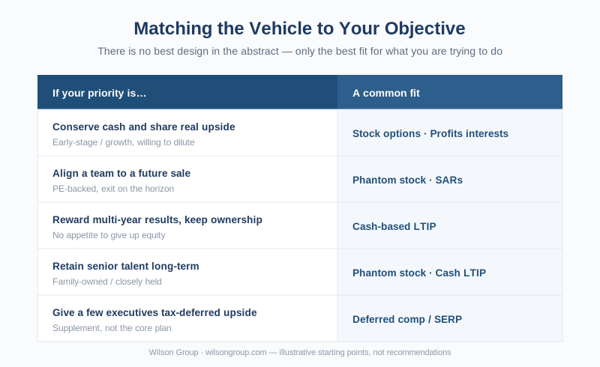
Matching the vehicle to your objective – illustrative starting points, not recommendations.
Executive benefits: Closing the qualified plan gap
Long-term incentives reward future growth. Executive benefits build targeted security for key people, often to close the gap that qualified plans like a 401(k) leave for highly compensated, where 401(k) limits fall short. Two models dominate:
Nonqualified deferred compensation (NQDC/SERPS) allows compensation growth under §409A. It is an unfunded, unsecured promise: the money remains a company asset exposed to general creditors (even a “rabbi trust”)
Section 162 Executive Bonus (REBA): The company pays a bonus funding an executive-owned life insurance policy. Currently taxable to the executive and deductible to the employer, it bypasses §409A (Modern Life). A REBA adds vesting rules for retention.
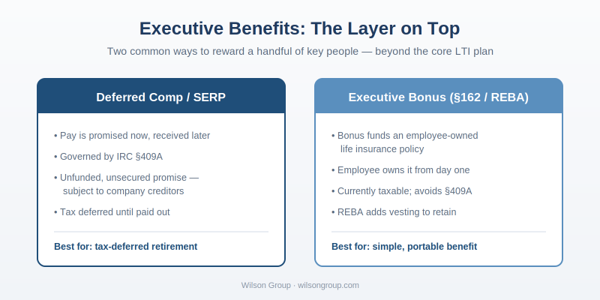
Executive benefits: deferred compensation / SERP versus a Section 162 executive bonus arrangement.
Three things we see go wrong
When LTI design skips the strategy and jumps to the vehicle, the same patterns recur:
- Rewarding the wrong horizon. A plan paying annually on single-year metrics is just a second bonus.
- Outrunning the valuation. Synthetic plans collapse without a defensible, repeatable valuation framework.
- Ignoring Cash Liquidity. Unfunded, cash-settled plans can create severe cash strain during high-growth vesting years.
Where to start
Resist the temptation to pick a vehicle first. Start with three questions:
What are we trying to reward – growth in value, or sustained performance?
Are we willing to share real equity?
What is the ultimate end point – a sale, succession or business as usual?
Your answers will narrow the choices quickly, and the right design will select itself.
Rethinking how you reward your leadership team?
Wilson Group has helped over 400 organizations design employee total compensation, executive rewards, and long-term incentive programs that fit their stage, ownership, and goals. Let’s talk
